 These bright and colorful hurricanes are perfect for summer. Light them at a party or outside on a patio. A great and simple gift for a good friend as well! Fill them with beautiful fresh cut flowers from your yard! $18.00 each
Saturday, May 8, 2010
Bright Mercury Glass Hurricanes
These bright and colorful hurricanes are perfect for summer. Light them at a party or outside on a patio. A great and simple gift for a good friend as well! Fill them with beautiful fresh cut flowers from your yard! $18.00 each
Antique-Inspired Stirrup Cups

I love these and would love to have them. Each is made of pewter and glass and consist of a moose and bear head. Inspired by the old traditional way of taking a drink before the hunt.
A stirrup cup is a "parting cup" given to guests, especially when they are leaving and have their feet in the stirrups. It is also the traditional drink (usually port or sherry) served at the meet, prior to a traditional foxhunt. The term can describe the cup that such a drink is served in.
In colloquial Highland Scots the host may well, in inviting his guest to stay briefly for that farewell drink, call it a "dochan doruis" (from Scottish Gaelic deoch an dorais, literally "drink of the door").
In Anya Seton's Katherine the custom occurs frequently before English royalty and nobility leave on travels abroad or pAnya Seton's Katherine rogresses. In G.G. Coulton's Chaucer and his England it is referred to in relation to the Canterbury pilgrims setting out.
In colloquial Highland Scots the host may well, in inviting his guest to stay briefly for that farewell drink, call it a "dochan doruis" (from Scottish Gaelic deoch an dorais, literally "drink of the door").
In Anya Seton's Katherine the custom occurs frequently before English royalty and nobility leave on travels abroad or pAnya Seton's Katherine rogresses. In G.G. Coulton's Chaucer and his England it is referred to in relation to the Canterbury pilgrims setting out.
Garden Lanterns
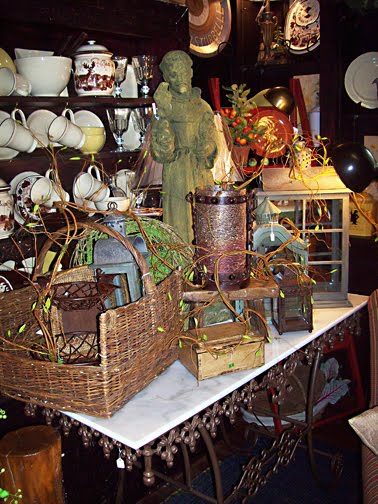 These great lanterns are so neat with a lit candle in them on your kitchen table or island. Hang them outside your back door and light them before a party. Hang them out on your patio or fill them with wonderful collections of photographs and collectibles.
The large Frenchy marble table in this picture is so great with a marble top and rustic iron finish-It has a great price at $345.00
Gathering of Friends Cookbook
 The Gathering of Friends Cookbook was created to cultivate the idea of food as a love language, empowering the reader with simple ideas to enhance mealtime. It has five weeks of creative menu planning, complete with shopping lists. Additional chapters feature effortless dishes, savory appetizers, garden fresh salads, hearty soups from the kitchen, and enchanting desserts, making this cookbook a splendid addition to every home.
 This beautiful book is such a wonderful gift-it's so inspiring and the pictures are so beautiful.
Baskets For Everyone
 We've just got in some fantastic baskets at the shop....They are large and have numerous possibilities! This one above looks great filled with horse appples. It would be great on a large coffee table or in the center of a large kitchen table.
 I could crawl in this one and hide for the day-what a great laundry basket these would make. Fill them with toys, magazines, a huge bundle of aspen leaves...
Sunday, May 2, 2010
Saint Francis in Garden
 Here is a great example of how wonderful they are in a flower filled garden....
A Saint Francis For Your Thoughts?
 We have recently got in these wonderful antiqued St. Francis garden statues at the shop. How aged and fantastic they are. My mother would love one of these guys for Mother's Day. He stands about four feet tall so he is a great size for your garden or flower bed. Often when we decorate houses pieces like this are brought from outside and worked up in displays. Just a little bit of age from outside makes them perfect and quite interesting inside!
Since I have seen these so many places and have never known anything about them except that he was a Saint-I thought I would post some interesting information about him...
 Saint Francis of Assisi (Giovanni Francesco di Bernardone; 1181/1182 – October 3, 1226) was a Catholic deacon and preacher. He also was the founder of the Order of Friars Minor, more commonly known as the Franciscans. He is known as the patron saint of animals, the environment and one of the two patrons of Italy (with Catherine of Siena), and it is customary for Catholic churches to hold ceremonies blessing animals on his feast day of 4 October.
 Many of the stories that surround the life of St. Francis deal with his love for animals. Perhaps the most famous incident that illustrates the Saint's humility towards nature is recounted in the "Fioretti" ("Little Flowers"), a collection of legends and folklore that sprang up after the Saint's death. It is said that, one day, while Francis was traveling with some companions, they happened upon a place in the road where birds filled the trees on either side. Francis told his companions to "wait for me while I go to preach to my sisters the birds". The birds surrounded him, drawn by the power of his voice, and not one of them flew away.
Another legend from the Fioretti tells that in the city of Gubbio, where Francis lived for some time, was a wolf "terrifying and ferocious, who devoured men as well as animals". Francis had compassion upon the townsfolk, and went up into the hills to find the wolf. Soon, fear of the animal had caused all his companions to flee, though the saint pressed on. When he found the wolf, he made the sign of the cross and commanded the wolf to come to him and hurt no one. Miraculously the wolf closed his jaws and lay down at the feet of St. Francis. "Brother Wolf, you do much harm in these parts and you have done great evil...", said Francis. "All these people accuse you and curse you... But brother wolf, I would like to make peace between you and the people". Then Francis led the wolf into the town, and surrounded by startled citizens made a pact between them and the wolf. Because the wolf had “done evil out of hunger”, the townsfolk were to feed the wolf regularly, and in return, the wolf would no longer prey upon them or their flocks. In this manner Gubbio was freed from the menace of the predator. Francis, ever the lover of animals, even made a pact on behalf of the town dogs, that they would not bother the wolf again. It is also said that Francis, to show the townspeople that they would not be harmed, blessed the wolf.
Legend has it that St. Francis on his deathbed thanked his donkey for carrying and helping him throughout his life, and his donkey wept.
Friday, April 30, 2010
Burgundy Beef Brisket
 Serves: 8
Ingredients
- 3-4 pound beef brisket
- 1/2 cup plus 1 tablespoon Stonewall Kitchen Burgundy Marinade(available at the shop!)
- 2-tablespoon light olive oil
- 1 Tablespoon butter
- 2 cloves garlic
- 3/4 cup carrots, 1-inch dice
- 3/4 cup celery, 1-inch dice
- 1 medium leek, 1-inch dice
- 1/2 cup red wine, such as burgundy
- 4 cups beef stock
- 2-tablespoon tomato paste
Kir Royale Sorbet
 Serves: 6-8
Ingredients
- 2 cups water
- 1 cup granulated sugar
- 1 jar Stonewall Kitchen Kir Royale Brunch Jam(Available now to pick up at the shop)
- To make a simple syrup combine the water and granulated sugar in a saucepan over medium high heat. Bring to a boil. Reduce heat and stir until the sugar is dissolved. Remove from heat.
- Place 1 jar of Stonewall Kitchen Kir Royale Jam in a food processor. Using a metal blade process jam until currents are fine pieces.
- Add pureed jam to the simple syrup and mix until uniform. Chill for at least 1 hour in the refrigerator.
- Place chilled mixture in an ice cream maker. Process for 30-35 minutes until the sherbet is thick and creamy. Freeze in freezer 8 hours or over night before serving. Can be kept frozen for one week in the freezer.
Monday, April 26, 2010
Blueberry Sour Cream Coffee Cake
 Drop by to pick up your jar of Stonewall Kitchen Wild Maine Blueberry Jam. Once one of our favorite baking mixes, we've broken down this delicious recipe for you to make and enjoy all on your own! Serves: 8-12
Ingredients
2 cups granulated sugar
2 cups all purpose flour
1 Tbsp vanilla extract
1 Tbsp baking powder
1/4 Tsp salt
2 sticks (1 cup) unsalted butter
2 eggs, beaten lightly
1 cup sour cream
1 - 13 oz. jar Stonewall Kitchen Wild Maine Blueberry Jam, stirred well
For the Crumb Topping:
1/4 cup plus 2 tablespoons brown sugar
1/4 cup granulated sugar
1/4 cup plus 3 tablespoons flour
1 cup walnuts, chopped
1 teaspoon cinnamon
4 tablespoons cold butter in pieces
click for directions here
Gift Wrapping
 If you didn't know we have complimentary gift wrapping at the store. And we're pretty good at it too! Need a special gift for someone and want it to be extra special? Let us help you pick out something and then have gift wrapped in our special papers and ribbons...
Friday, April 23, 2010
French Pastries & The Eiffel Tower
 Perhaps Mexican Food in Texas will cheer me up tonight as I look at these beautiful pictures from Miss Venita...sigh.....I would rather have an Éclair or a Pain au Chocolat!
While all patisseries will have their own variations and unique creations, there is definitely a standard array of flaky, buttery treats you are sure to find at most pastry shops around France. It's also highly recommended asking the patissier which pastry he or she thinks is best that day–as sometimes different specialties are made on different days of the week.
Here is a link of some of the tastiest pastries in France and recommendations-now can you pronounce them???
http://www.francetravelguide.com/french-pastries.html
 The Eiffel Tower is a 19th century iron lattice tower located on the Champ de Mars in Paris that has become both a global icon of France and one of the most recognizable structures in the world. The Eiffel Tower, which is the tallest building in Paris, is the single most visited paid monument in the world; millions of people ascend it every year. Named after its designer, engineer Gustave Eiffel, the tower was built as the entrance arch for the 1889 World's Fair.
The tower stands 324 m (1,063 ft) tall, about the same height as an 81-story building. It was the tallest man-made structure in the world from its completion until 1930, when it was eclipsed by the Chrysler Building in New York City. Not including broadcast antennas, it is the second-tallest structure in France, behind the Millau Viaduct, completed in 2004.
 The structure was built between 1887 and 1889 as the entrance arch for the Exposition Universelle, a World's Fair marking the centennial celebration of the French Revolution. Eiffel originally planned to build the tower in Barcelona, for the Universal Exposition of 1888, but those responsible at the Barcelona city hall thought it was a strange and expensive construction, which did not fit into the design of the city. After the refusal of the Consistory of Barcelona, Eiffel submitted his draft to those responsible for the Universal Exhibition in Paris, where he would build his tower a year later, in 1889.
Three hundred workers joined together 18,038 pieces of puddled iron (a very pure form of structural iron), using two and a half million rivets, in a structural design by Maurice Koechlin. The co-architects of the Eiffel Tower were Emile Nouguier, Maurice Koechlin and Stephen Sauvestre. The risk of accident was great, for unlike modern skyscrapers the tower is an open frame without any intermediate floors except the two platforms. However, because Eiffel took safety precautions, including the use of movable stagings, guard-rails and screens, only one man died. The tower was inaugurated on 31 March 1889, and opened on 6 May.
The tower was met with much criticism from the public when it was built, with many calling it an eyesore. Newspapers of the day were filled with angry letters from the arts community of Paris. One is quoted extensively in William Watson's US Government Printing Office publication of 1892 Paris Universal Exposition: Civil Engineering, Public Works, and Architecture: “And during twenty years we shall see, stretching over the entire city, still thrilling with the genius of so many centuries, we shall see stretching out like a black blot the odious shadow of the odious column built up of riveted iron plates.” Signers of this letter included Jean-Louis-Ernest Meissonier, Charles Gounod, Charles Garnier, Jean-Léon Gérôme, William-Adolphe Bouguereau, and Alexandre Dumas.
Novelist Guy de Maupassant—who claimed to hate the tower—supposedly ate lunch in the Tower's restaurant every day. When asked why, he answered that it was the one place in Paris where one could not see the structure. Today, the Tower is widely considered[by whom?] to be a striking piece of structural art.
One of the great Hollywood movie clichés is that the view from a Parisian window always includes the tower. In reality, since zoning restrictions limit the height of most buildings in Paris to 7 stories, only a very few of the taller buildings have a clear view of the tower.
Eiffel had a permit for the tower to stand for 20 years, meaning it would have had to be dismantled in 1909, when its ownership would revert to the City of Paris. The City had planned to tear it down (part of the original contest rules for designing a tower was that it could be easily demolished) but as the tower proved valuable for communication purposes, it was allowed to remain after the expiration of the permit. The military used it to dispatch Parisian taxis to the front line during the First Battle of the Marne, and it therefore became a victory statue of that battle.

Subscribe to:
Posts (Atom)